A PRACTICAL STACK, CHOSEN WITH PURPOSE

Technologies I Use to Build Modern Websites

A good technology stack starts with what your business needs to do. The right combination makes a website useful today and manageable after launch.

I work with PHP, Python, Flutter, WooCommerce and the HTML, CSS and JavaScript foundations of the web. Each project uses the parts it needs. A service website, an online store and a mobile application call for different decisions.

Find an approach for your project
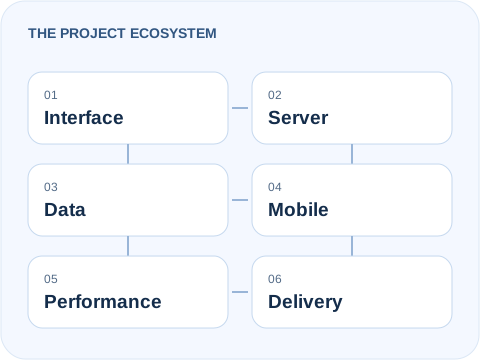
Six connected project layers: interface, server, data, mobile, performance and delivery.
Connected decisions, rather than a collection of fashionable tools.
FROM THE INTERFACE TO THE SERVER

What each layer contributes

Performance, security and maintainability depend on how these parts are implemented together.

Frontend development

Semantic HTML provides structure. CSS controls responsive layouts, spacing and typography. JavaScript adds interactions where they help, while essential navigation and information stay available as HTML.

SVG suits sharp, lightweight diagrams. WebP can reduce image transfer size when the result remains suitable. Modern browser APIs support local image processing and other focused features without requiring a large frontend framework.

Business website design ↗

Backend development

PHP handles server-side website behavior such as form processing and dynamic pages. Python can support backend applications, automation and data processing. The existing hosting environment and integration needs influence the choice.

Database-driven projects may use MySQL for structured records. REST APIs connect systems, while server-side validation, appropriate authentication and access controls protect each operation. A public information site does not need a database simply to look professional.

Custom website development ↗

Mobile applications

Flutter is an application framework, with Dart as its language. It supports shared interface and application code across supported platforms, including Android.

My experience includes Flutter. Before choosing a cross-platform architecture, we assess device features, API access, offline needs and release requirements. Shared code still needs platform-specific testing; a mobile-friendly website may be the simpler solution.

View the application project context ↗

E-commerce development

WordPress provides content management; WooCommerce adds online-store capabilities. My WooCommerce experience supports projects where the catalogue, product information and order workflow fit that platform.

PHP integrations can connect additional business logic. Payment gateways need provider approval, appropriate currencies, secure callbacks and verified test transactions. Catalogue structure, order management, plugin updates and recurring costs belong in the brief.

Explore e-commerce development ↗
TOOLS SUPPORT THE PROCESS

Build, check and maintain

Editors and collaboration tools help organize work. Git records changes; GitHub can host repositories and reviews; Visual Studio Code is one editor option. Their presence alone does not establish code quality.

Browser DevTools help investigate layout, network requests and runtime behavior. Lighthouse and PageSpeed Insights provide lab diagnostics; Google Search Console can reveal indexing and search data when the owner grants access. Cloudflare can sit in front of hosting for DNS, caching and delivery configuration.

This website uses Cloudflare and has local Lighthouse and browser-test evidence. Tool access and account configuration are agreed for each project; this is not a claim that every listed tool is used in every engagement.

Performance and technical SEO ↗
REQUIREMENTS BEFORE POPULARITY

Choosing the right technology

We balance functionality, budget, hosting, security, performance, expected growth and long-term support. The simplest maintainable solution that meets the brief is a useful starting point.

01

Explain your business

For a service site with enquiry forms, focus on clear content, fast pages and reliable server-side processing. A large application stack may add unnecessary maintenance.

02

Sell and manage orders

Consider WooCommerce when its product and order model fits. Assess integrations and operating costs before deciding whether a custom system is justified.

03

Support a business workflow

For logins, records and integrations, define permissions and data flows first. PHP or Python may suit the backend, depending on the environment and support plan.

04

Reach people on mobile

Start by separating responsive website needs from device-specific app needs. Evaluate Flutter where a mobile application and its ongoing releases are justified.

Compare languages, frameworks and platforms ↗
TALK DIRECTLY WITH HARIPRASAD

Have a Website or Application Project?

Share what you need to build, who will use it and any existing systems. We can discuss the scope before choosing the tools.

Discuss Your Project on WhatsApp (opens in a new tab)