LANGUAGES · FRAMEWORKS · PLATFORMS

Programming Languages and Frameworks I Work With

Understand the role behind each name, then choose around the project.

My existing experience covers PHP, Python, JavaScript, HTML, CSS, Flutter and WooCommerce. This guide also explains related technologies and the wider ecosystem; inclusion does not imply a professional specialization in every item.

Compare practical uses
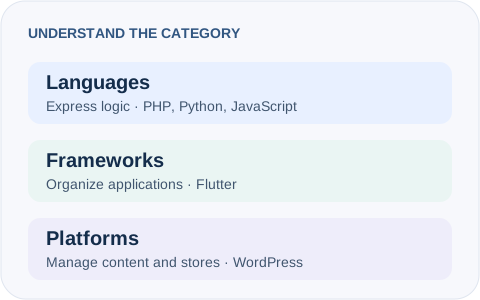
Three different categories: languages express logic, frameworks organize applications, and platforms provide managed features.
A programming language, a framework and a content platform solve different problems.

PHP

PHP runs on the server to build dynamic websites, process forms and connect to databases or APIs. It can support custom business systems as well as smaller websites.

For custom work, I consider validation, access control, database queries, deployment and maintenance together. A supported runtime and a clear update plan matter throughout the website's life.

Plan custom website functionality ↗

Python

Python can power web backends, automation, data processing and API integrations. A custom script may handle a focused task without becoming a complete web application.

My experience includes Python. A web application also needs an appropriate framework, hosting process, dependencies and operational support. We confirm those requirements before choosing it for a particular brief.

JavaScript

JavaScript supports dynamic interfaces, browser APIs and lightweight frontend interactions. It can improve a form or tool without turning every page into a complex application.

Client-side validation helps visitors correct mistakes, but it never replaces server-side checks. Essential content and links should stay accessible, with scripting added where the interaction calls for it.

HTML and CSS

HTML is a markup language; CSS is a stylesheet language. They are not general-purpose programming languages. Together they create semantic structure, responsive layouts and usable visual hierarchy.

Accessible labels, keyboard focus, readable text and restrained styling are part of the implementation. Performance depends on the actual page, assets and delivery, not on a claim that one styling method always wins.

Flutter and Dart

Flutter is an application framework and Dart is its programming language. Flutter is part of my technical experience; Dart is the language used to implement Flutter applications.

Shared UI code can support Android and other target platforms, but device integrations, navigation, screen sizes and releases need specific testing. This is distinct from making an ordinary website responsive.

Java in the wider ecosystem

Java is relevant to backend services and the Android ecosystem. Existing Java systems can influence integration requirements or the skills needed for future maintenance.

I do not present Java as a verified client-project specialization here. If a brief depends on an established Java codebase, we first assess the work and confirm suitable expertise before agreeing to delivery.

WordPress and WooCommerce

WordPress is a content platform; WooCommerce is an e-commerce plugin for it. Neither is a programming language. They provide a foundation for managing pages, products and orders.

My experience includes WooCommerce. Platform projects still need deliberate theme/plugin selection, payment testing, backups, security updates and content ownership. Custom PHP integrations should respect the update process.

Discuss an online store ↗
A PROJECT FIT GUIDE

Compare the role, benefits and trade-offs

No language is automatically the fastest or most secure. Architecture, implementation, hosting and maintenance affect the outcome.

Technology selection guide
TechnologyPrimary purposeSuitable projectsMain advantageImportant consideration
PHPServer-side logicDynamic websites, forms, business recordsFits many existing web-hosting environmentsSupported runtime, validation and maintenance
PythonBackend logic and automationWeb APIs, data workflows, scriptsUseful across application and automation tasksApplication hosting and dependency management
JavaScriptBrowser interactionInteractive interfaces and browser toolsWorks with built-in browser APIsLoading cost, accessibility and server validation
HTML / CSSStructure and presentationEvery web interfaceSemantic, responsive foundationsReadable layouts and cross-device testing
Flutter / DartApplication UI and logicAndroid and cross-platform appsShared application code where appropriatePlatform integrations and release testing
JavaApplication/backend logicExisting Java systems and integrationsEstablished ecosystemSpecialist delivery experience must be confirmed
WordPress / WooCommerceContent and store managementBusiness sites and online shopsEstablished editing and order workflowsPlugin fit, ongoing updates and operating costs
PRACTICAL QUESTIONS

Start with the requirement

A short brief makes technology discussions more useful than a list of preferred tools.

Which programming language is best for a business website?

There is no universal best choice. The pages, editing needs, forms, integrations, budget and support arrangements determine the fit. HTML and CSS provide the interface foundations; PHP or a content platform may handle the server-side needs.

Is PHP still suitable for modern websites?

PHP can support modern dynamic websites, APIs and forms. Use a supported runtime, appropriate security controls and maintainable code. Suitability depends on the implementation and hosting rather than the language name alone.

When should a business choose a custom PHP website?

Consider custom PHP when workflows or integrations need behavior that an existing platform cannot provide cleanly. Agree on access control, data handling, handover and ongoing support before committing to custom development.

What is Flutter used for?

Flutter is used to build application interfaces with Dart, including Android and other supported platforms. It can share code across targets, but platform-specific features and releases still need testing.

Can Python be used for web applications?

Yes. Python can run backend web applications and APIs with suitable libraries or frameworks. Confirm that the hosting supports the application process and that dependencies and updates can be maintained.

What technologies are suitable for an online store?

WooCommerce may suit a store whose catalogue, payments and order process fit its model. More specialized workflows may justify integrations or a custom application. Compare ongoing maintenance and operating costs, not only the initial build.

TALK DIRECTLY WITH HARIPRASAD

Need Help Choosing the Right Technology?

Share what you need to build, who will use it and any existing systems. We can discuss the scope before choosing the tools.

Discuss Your Project on WhatsApp (opens in a new tab)